As companies expand globally, leadership teams increasingly ask strategic questions:
What does offshoring mean in today’s business environment?
What is the difference between shared services and outsourcing?
How do nearshore vs offshore decisions impact cost optimization and enterprise operations?
The answers determine how efficiently organizations scaletheir global workforce while protecting margins and maintaining control.
This article breaks down offshore outsourcing, nearshore outsourcing, shared services, and how modern enterprises structure global operations for measurable ROI.
Let us start with clarity.
Offshoring refers to relocating business processes or operations to another country, typically to reduce costs, access specialized talent, or extend operational coverage.
An offshoring company may move IT support, customer service, finance operations, or software development to countries with lower labor costsor stronger technical ecosystems.
Offshoring companies often operate in regions such as India, Eastern Europe, Southeast Asia, or Latin America.
However, offshoring does not always mean outsourcing.
One of the most searched questions is offshoring vs outsourcing.
They are not identical.
Moving operations to another country. The work may still be managed internally.
Hiring a third-party provider to perform a business function.
When combined, offshore outsourcing occurs when a company hires an external vendor in another country.
For example:
A US company hiring a software development firm in India is offshore outsourcing.
A US company building its own dedicated development centerin another country is offshoring, but not outsourcing.
This distinction matters when evaluating control, compliance, and strategic ownership.
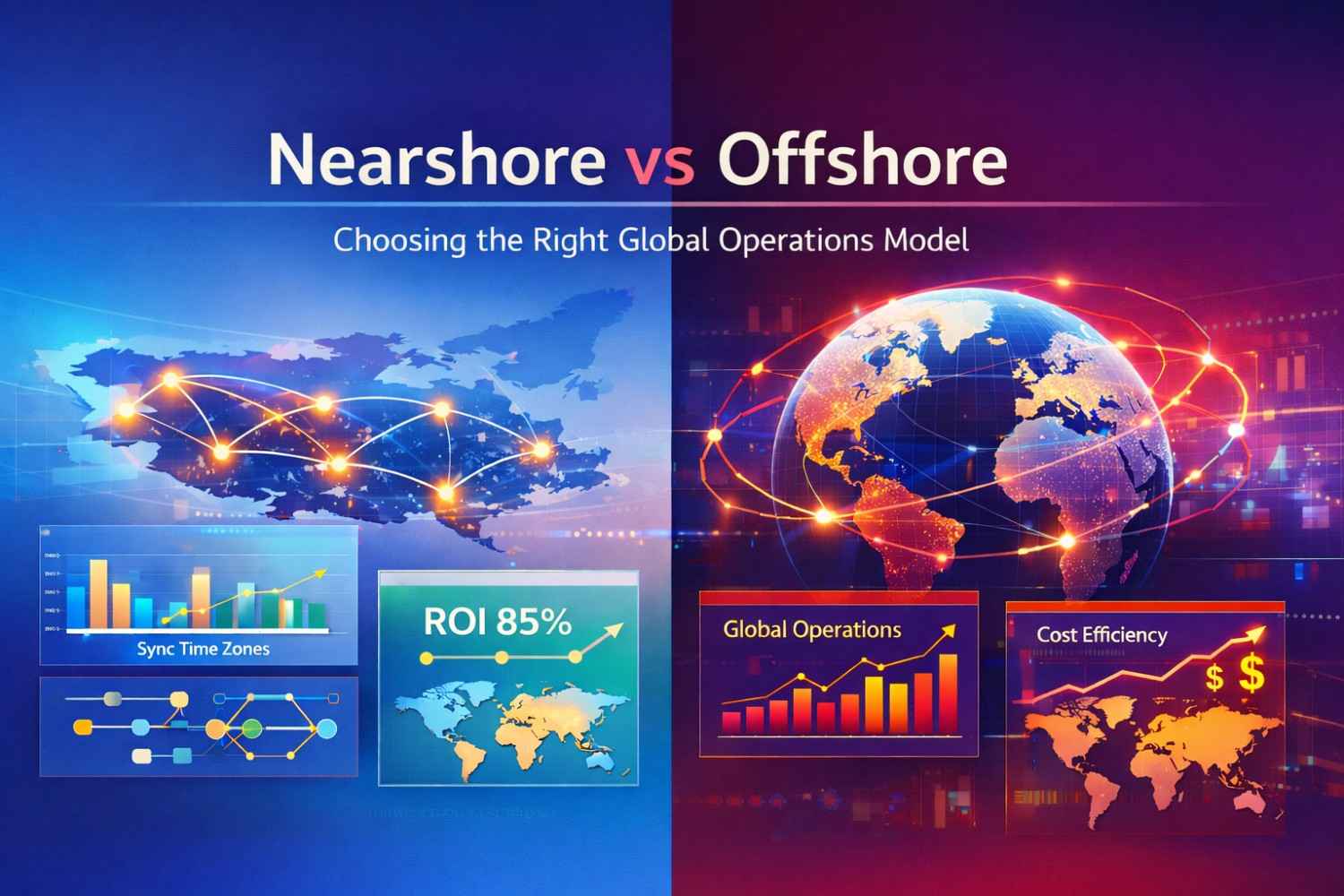
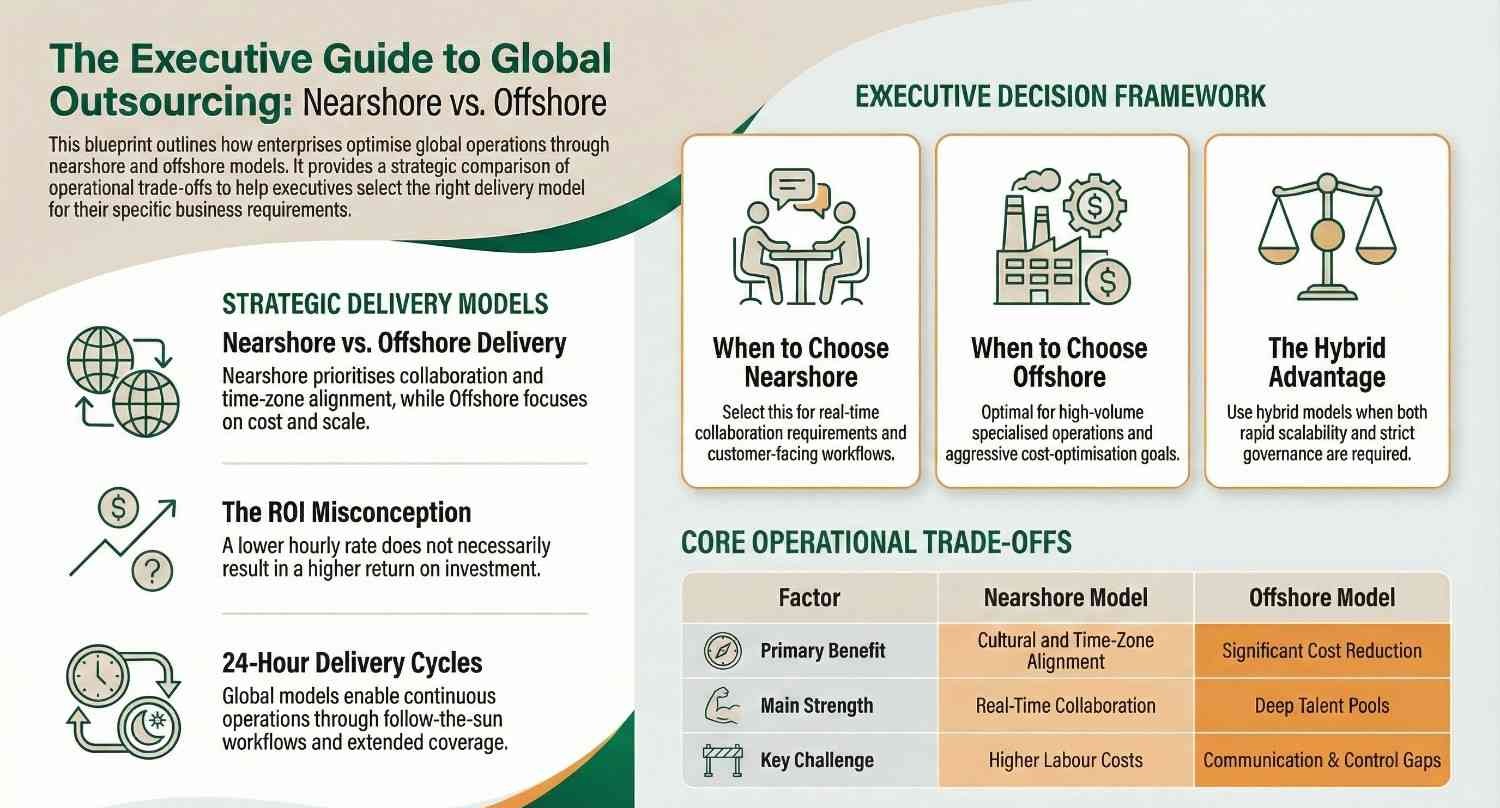
Nearshore vs offshore is a critical decision point in global expansion.
Nearshore outsourcing involves partnering with providers in neighboring or time zone-aligned countries. For US companies, this often includes Latin America.
Offshore outsourcing typically involves more distant regions such as South Asia or Eastern Europe.
Time zone alignment
Nearshore outsourcing provides easier collaboration during US business hours.
Cost structure
Offshore outsourcing may offer lower direct labor costs.
Cultural proximity
Nearshore team may align more closely with US business practices.
Scalability
Offshoring companies in large talent markets may offer deeper specialization.
The choice depends on your enterprise operations priorities.
Organizations exploring global operations ask:
What are the core benefits of offshoring or outsourcing overseas?
The primary advantages include:
Labor arbitrage can reduce operational expenses significantly while preserving quality.
Companies tap into specialized engineers, analysts, AI trainers, and healthcare support professionals not easily available locally.
Global operations allow round-the-clock service delivery and faster turnaround times.
Focus on core strategy
By relocating repetitive processes, leadership can concentrate on innovation and revenue growth.
However, outsourcing overseas pros and cons must beevaluated carefully.
Pros
• Reduced operating costs
• Access to specialized technical talent
• Increased operational scalability
• Faster project delivery cycles
Cons
• Data security and compliance risk
• Communication challenges
• Cultural differences
• Reduced direct control
This is why many enterprises combine offshore outsourcing with structured governance frameworks or build shared services centers toretain oversight.
A shared services model centralizes common business functions into one internal unit that serves multiple departments or regions.
A shared services centre typically handles:
• Finance and accounting
• Human resources
• Procurement
• IT support
• Compliance
What are the core benefits of a shared services model for large organizations?
The benefits include:
• Process standardization
• Improved cost optimization
• Enhanced data visibility
• Stronger enterprise operations control
• Reduced duplication across departments
Shared services differ from outsourcing because the function remains internal.
This is a frequent executive question.
Internal consolidation of functions within the organization.
External vendor performing the function.
In shared services, the company owns the team and processes.
In outsourcing, the vendor owns delivery execution.
Some companies combine both models within a broader global business services strategy.
When evaluating offshoring companies for IT development, pricing transparency becomes critical.
How do you compare pricing models for software development offshoring providers?
Common pricing models include:
Fixed price
Best for clearly defined project scopes.
Time and material
Flexible model where billing depends on actual hours worked.
Dedicated team
Monthly fee for a committed offshore workforce aligned to your organization.
When comparing providers, consider:
• Hourly rates versus total project cost
• Quality assurance standards
• Talent seniority levels
• Governance structure
• Long-term scalability
Cheaper rates do not always mean better ROI.
While specific rankings change frequently, top offshoring companies typically offer:
• IT infrastructure management
• Software development
• Cloud migration
• AI model support
• Cybersecurity monitoring
Enterprises should evaluate providers based on:
• Industry specialization
• Data security compliance
• Client case studies
• Scalability track record
Reputable companies offering IT development services overseas often provide transparent onboarding, compliance documentation, andmeasurable KPIs.
Managing offshore or nearshore outsourcing requires structured tools.
Platforms commonly used include:
• Project management systems
• Cloud collaboration suites
• Code repository management tools
• Time tracking and analytics dashboards
• Cloud-based shared services platforms
Which companies offer cloud-based shared services platforms?
Major enterprise technology vendors provide solutions that integrate finance, HR, procurement, and IT support into centralized dashboards.
These platforms improve visibility across global operations and strengthen performance tracking.
US manufacturers and technology companies increasingly search for:
Top companies offering nearshoring services for US manufacturers
Find nearshoring partners for software development.
Compare costs for nearshore customer support services
When selecting nearshore outsourcing partners, evaluate:
• Industry experience
• Technical certifications
• English proficiency
• Infrastructure stability
• Data protection policies
Compare not only hourly cost but also productivity, retention rates, and governance maturity.
Compare costs for nearshore customer support services byanalyzing:
• Labor rates
• Training investment
• Quality monitoring standards
• Attrition rates
• Time zone overlap advantages
Sometimes, nearshore outsourcing provides slightly higher labor costs than offshore options but delivers better communication efficiency and faster issue resolution.
The ROI depends on your service complexity and customer expectations.
Enterprise operations today require more than simple cost-cutting.
A mature global operations strategy blends:
• Offshore outsourcing for specialized high-volume tasks
• Nearshore outsourcing for time-sensitive collaboration
• Shared services centre for internal process control
• Strong governance for compliance and data security
Companies that strategically combine these models outperform those relying on a single delivery structure.
The debate between nearshore vs offshore is not about geography alone. It is about control, cost optimization, compliance, and long-term scalability.
Understanding the meaning of offshoring, offshoring vs outsourcing, and shared services models helps executives design smarter enterprise operations.
The real objective is not simply to move work overseas.
The objective is to build a global workforce model that strengthens innovation, protects margins, and supports sustainable growth.
For companies navigating offshore outsourcing, nearshore outsourcing, and shared services strategy, the right structure can transform global operations into a competitive advantage rather than a cost center.
Trust TRANSFORM Solutions to be your partner in operational transformation.
Trust TransForm Solutions to be your partner in operational transformation.